



Each plays an important role on its own. But when they work together, operators gain a clearer picture of what's happening across their parking facilities.
The questions you can't quite answer
Most operators will recognise at least one of these:
- "We're full by 10am, but how many of those cars are actually paying?"
- "Did that vehicle get an infringement because no one knew a tenant had validated it?"
- "Is our customer validation programme bringing people in, or just discounting people who'd have come anyway?"
- "Level 3 sits half empty most afternoons. Should we be pricing it differently?"
Each of these sits in the space between systems. When occupancy, validation and enforcement operate independently, valuable information can get lost between them.
An enforcement officer may have no way of knowing a vehicle was validated by a tenant down the road. Occupancy numbers can show a full car park without showing how much of it is on complimentary or discounted parking. And a validation programme can run for months with no clear view of what it's doing to demand.
Every one of those gaps turns into a manual check, a disputed infringement, or a decision made on half the data.
What each one tells you
Occupancy shows how parking spaces are being used, helping you understand demand and make informed decisions about pricing, staffing and space. Which levels fill first, when the peaks land and where capacity sits empty on a quiet weekday all feed into those decisions.
Validation makes it easier to manage parking entitlements, whether that's complimentary parking for customers, discounted rates for visitors or access for authorised users. Done well, the right rate lands on the right session without anyone stamping tickets at reception or reconciling it all by hand at the end of the month.
Enforcement helps ensure parking rules are followed, identifying vehicles that haven't met the conditions of their stay. It protects revenue and keeps spaces free for the people who are actually meant to be using them.
On its own, each one answers part of the question. None of them answers all of it.
What changes when they're connected
Connect them, and those questions start to answer themselves. You can make better decisions, reduce manual processes and create a more seamless parking experience.
- Occupancy data shows not just how full the site is, but who's parked, on what terms, and whether they're compliant.
- Validated vehicles are recognised automatically, so enforcement only follows up genuine breaches.
- Validation activity sits alongside real demand data, so you can see what your programmes are actually doing.
- End-of-month reconciliation becomes a report you pull, not a job you do.
- Parkers get the entitlement they were promised, without having to argue for it afterwards.
What you can do with Inugo
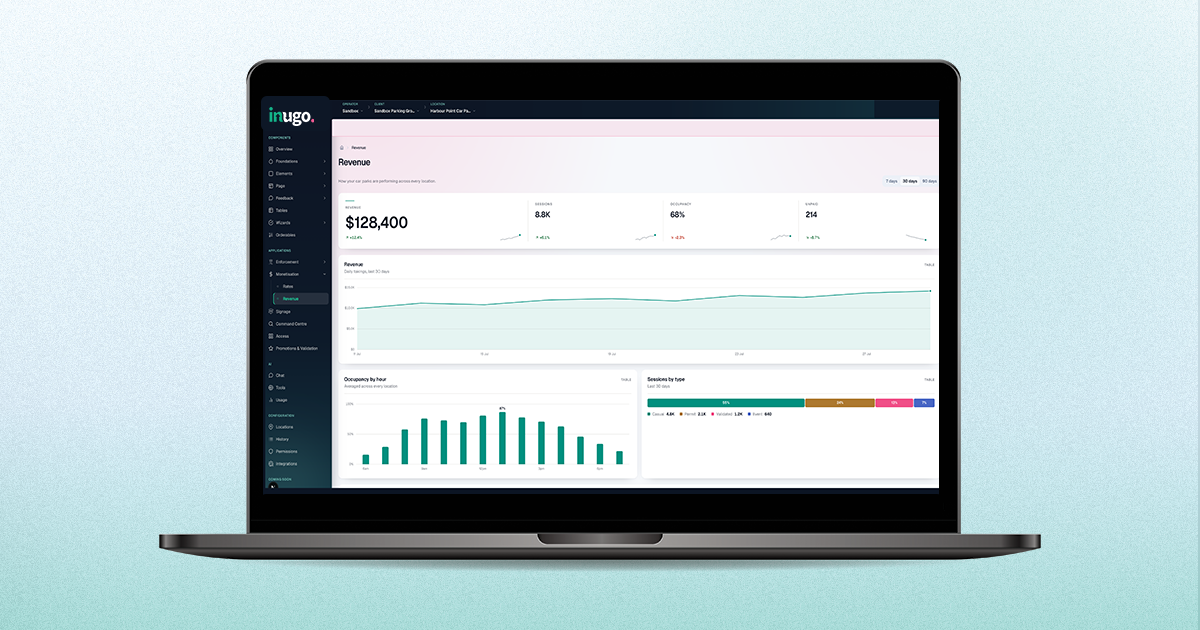
Inugo runs occupancy, validation and enforcement from the same Management Portal, so every session, validation and violation sits in one place. Here's what that looks like in practice.
Occupancy
- See real-time occupancy by site, lot and zone, powered by LPR entry and exit data.
- Break occupancy down by user group, so you know how much of the car park is staff, permit holders, visitors or validated customers.
- Download historical occupancy reports to compare periods, events or sites and spot where capacity runs tight or sits unused.
- Use those patterns to set different rates by user type, time of day, zone or site.
Validation
- Validate through promo codes, QR scans, Bluetooth beacons at a reception desk, kiosks, staff or tenant portals, or the app.
- Apply a percentage off, a fixed amount off, or switch the parker to a different rate entirely.
- Set duration limits and usage caps per user or in total.
- Let multiple tenants validate their own customers without needing separate hardware.
- Place a pre-authorisation hold that releases automatically once a validation is confirmed.
- Export a full validation history, timestamped and attributable to a user, to bill tenants for the discounts given on their behalf.
Enforcement
- Set site rules, time limits, booking conditions and exemptions centrally, and apply them consistently across every site.
- Check plates in real time against active sessions, bookings, permits and validations, so a validated vehicle is never flagged as a breach.
- Detect overstays and unpaid sessions automatically from entry and exit data, with timestamps and evidence captured at the time of detection.
- Issue citations automatically via ANPR or manually through the app, then carry them through ownership lookup, mailing, debt collection and appeals.
- Send violation data to your existing enforcement provider, or work it on-site through the Inugo app.
All three, together
Because everything sits in one portal, reporting covers revenue, occupancy, access activity, enforcement violations and validation usage side by side, in real time and historically, and all of it can be exported.
The bit that matters
Smarter parking isn't just about having the right technology. It's about making sure that technology works together.