



HOW IT WORKS
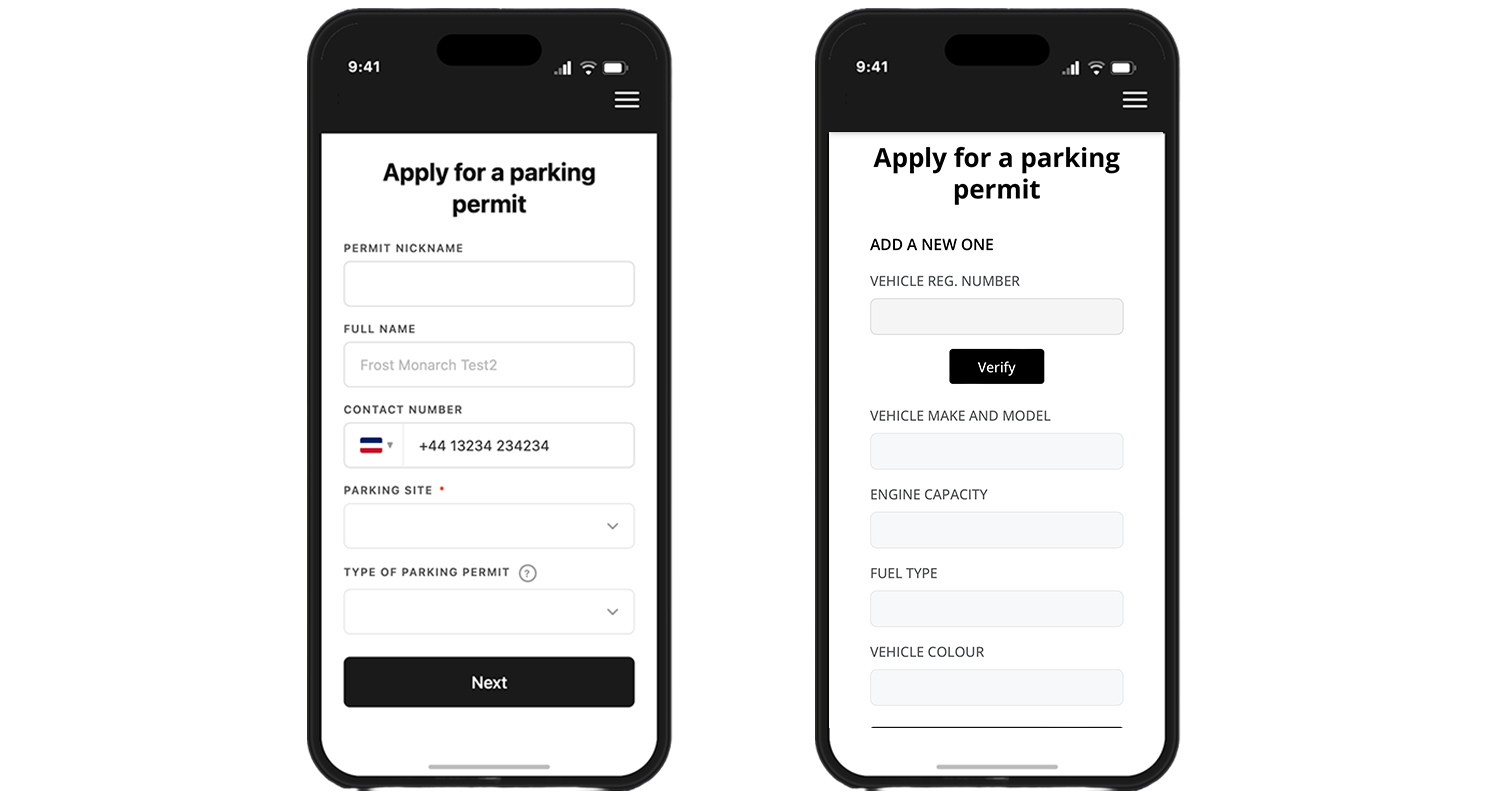
Applicants — residents, staff, contractors, visitors, students, or any custom permit type an operator defines — apply for a permit themselves through a self-service flow. Rules-based prioritisation decides who gets access when there's more demand than space, with automatic waitlisting for anyone who doesn't get a spot straight away. Approval workflows can run automatically for straightforward cases or route to a person for manual sign-off where a judgement call is genuinely needed. Once approved, the permit holder manages and tracks their own permit — checking status, updating details, or requesting a change — without a call to the office.
WHERE IT MATTERS THE MOST
Universities run some of the most complex permit operations anywhere: staff permits, student permits split by year or faculty, carer and accessible permits, and visitor permits for open days, all competing for a fixed number of spaces that changes as buildings come on and offline. Rules-based prioritisation and waitlisting mean a university can encode its actual allocation policy into the system once, rather than a staff member manually deciding who gets the next available space every time one opens up.
Councils face a similar challenge with resident and visitor permits, particularly in areas where demand outstrips supply and a clear, defensible prioritisation policy matters as much for fairness as for admin efficiency. Hospitals need to manage staff permits alongside carer and contractor access, often across multiple sites with different eligibility rules for each. Corporate campuses and business parks use the same system for contractor access — a short-term, clearly bounded permit type that shouldn't need the same manual process as a year-long staff permit.

SWITCHING WITHOUT STARTING FROM ZERO
Operators moving off a legacy permit system don't have to re-enter every existing permit by hand. Our Import tool brings existing permit data — holders, plates, validity periods, permit types — into Inugo in one migration rather than a manual data entry project that delays the whole switch. That matters more than it might sound: a messy or incomplete migration is one of the most common reasons operators put off replacing a permit system that's clearly not working for them anymore.
WHAT OPERATORS KEEP CONTROL OF
Self application doesn't mean unsupervised. Every permit allocation and change is logged in a full audit trail, so a question about who approved what, and when, has an answer. Operators can still step in manually wherever it's needed — overriding an automated decision, adjusting a waitlist, or approving an exception — the system just doesn't require that intervention for every single permit that comes through.
A QUIETER OPTION WORTH KNOWING ABOUT
Permit holders can sublet their own permit where an operator allows it — useful for a monthly parker who's away for a period and wants someone else to use their space rather than let it sit empty, tracked and permissioned the same way as any other permit activity.
WHY THIS CHANGES THE MATHS ON PERMIT ADMIN
A permit system that requires manual review of every application scales badly — twice the permit holders roughly means twice the admin work. A system built around self-service application and automated prioritisation doesn't have that problem. The admin burden stays close to flat as the number of permit holders grows, which is the difference between a permit programme an operator can expand with confidence and one they're reluctant to grow because they know what it'll cost them in staff time.